Renting a residential property involves more than signing a rental agreement and handing over the keys. Landlords often want to know who will occupy their property, while tenants may also want a transparent and professional rental process.
Tenant verification in Mumbai is a process of collecting and checking relevant information about a prospective tenant. Depending on the situation, this can involve identity details, permanent address information, employment information, references, rental records, and information submitted through the appropriate police or other verification channels.
For Mumbai residents, it is important to distinguish between tenant information submission and a police NOC. Mumbai Police currently states that a police NOC is not required for renting a flat or house, while it provides a tenant-information service for properties within the Brihanmumbai Police Commissionerate. The service can be completed online, submitted to the concerned police station, or sent through registered post.
What Is Tenant Verification in Mumbai?
Tenant verification in Mumbai generally means checking relevant information supplied by a person who is going to rent a residential property.
The purpose is to help establish that the information provided by the prospective tenant is consistent and can be reasonably confirmed through appropriate sources.
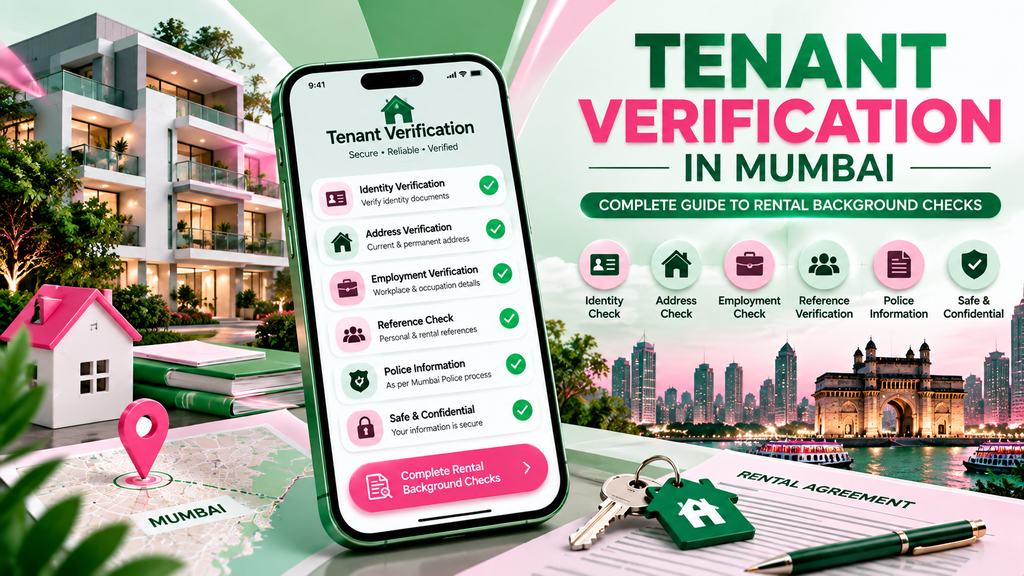
Depending on the circumstances, verification may involve information such as:
- Full name
- Photograph
- Identity information
- Permanent address
- Current contact details
- Employment or occupation details
- Rental property details
- References
- Relevant supporting documents
Mumbai Police’s current tenant-information form specifically includes property-owner details, rented-property details, tenant details, tenant workplace information, and information about people who know the tenant. It also asks for identity-proof information and a copy of the relevant identity document.
Why Tenant Verification Matters for Landlords
A landlord is trusting a tenant with access to a private property, belongings, and sometimes shared residential facilities. A structured verification process can help reduce uncertainty before the tenancy begins.
Tenant verification may help a property owner:
Confirm Basic Identity Information
Checking that the tenant’s name and supporting identity information are consistent can reduce errors in rental records.
Review Address Information
A tenant’s permanent address can provide another point of reference when reviewing the information provided during the rental process.
Understand Employment Details
Where appropriate and with suitable authorization, employment information can help a landlord understand the tenant’s stated occupation and workplace details.
Maintain Better Rental Records
Keeping accurate tenant information can make property administration easier, especially when landlords manage multiple properties.
Support a More Organized Rental Process
A documented process can be clearer for both the owner and tenant than informal verbal checks.
What Information Can Be Verified?
The exact scope of verification depends on the purpose of the check, the documents supplied, and the lawful sources available.
A typical tenant verification process may examine several categories.
Identity Verification
This involves checking whether the identity information supplied by the prospective tenant is consistent with the documents provided.
The verification should focus on relevant information rather than collecting unnecessary personal details.
Address Verification
A permanent or previous address can be reviewed using appropriate documents or lawful verification methods.
Address information may be particularly useful where a tenant has recently moved to Mumbai from another city or state.
Employment Verification
Where employment details are relevant, a verification process may confirm the workplace or occupation information supplied by the tenant, subject to appropriate authorization and lawful handling of personal information.
Reference Verification
A landlord may ask for references who can confirm basic information about the prospective tenant.
References should be contacted professionally and only for a legitimate verification purpose.
Rental History
Where relevant information is voluntarily provided and can lawfully be checked, previous rental history may help a landlord understand past tenancy arrangements.
However, claims about previous rental disputes or misconduct should not be treated as facts without reliable supporting evidence.
Tenant Information and Mumbai Police
Mumbai Police provides an official Tenant Information service for properties falling within the Brihanmumbai Police Commissionerate.
According to the current Mumbai Police portal, landlords can provide rental information through three routes: online submission, direct submission to the concerned police station, or registered post. The same page states that the landlord and tenant should ensure the submitted information is true.
The portal currently requests information such as:
- Property owner’s details
- Rented-property address
- Agreement start and end dates
- Tenant’s name and photograph
- Permanent address
- Identity-proof details
- Co-resident information
- Tenant’s workplace and occupation
- Tenant’s contact information
- Details of people who know the tenant
This means landlords in Mumbai should use the current official procedure rather than relying on older articles that may describe a different process.
Is a Police NOC Required for Tenant Verification in Mumbai?
No. Mumbai Police’s current tenant-information page explicitly states that a Police NOC is not required for renting a flat or house. Instead, citizens can furnish tenant information through the methods provided by Mumbai Police.
This distinction is important because the terms “tenant verification,” “police verification,” and “police NOC” are sometimes used interchangeably even though they do not necessarily mean the same thing.
Landlords should check the latest official Mumbai Police instructions applicable to their property instead of assuming that an NOC is mandatory.
How the Tenant Verification Process Works
A professional tenant verification process can be organized into several stages.
Step 1: Collect Required Information
Start with information relevant to the tenancy, such as the tenant’s identity, contact details, permanent address, occupation, and property-related details.
Step 2: Check Supporting Documents
Review the documents provided by the tenant and compare key details for consistency.
The goal is not to collect every possible document, but to obtain information that is relevant to the verification purpose.
Step 3: Conduct Appropriate Verification
Relevant details may be checked through official channels, documented references, or other lawful sources.
A professional investigator should clearly distinguish between verified information, information supplied by the applicant, and information that could not be independently confirmed.
Step 4: Review Inconsistencies
If different documents contain different addresses, names, dates, or other details, those differences should be reviewed before concluding.
An inconsistency does not automatically mean that a person has provided false information. There may be legitimate explanations, such as a recent move or an administrative error.
Step 5: Prepare the Verification Report
A useful report should present relevant findings clearly and avoid unsupported conclusions.
A professional report may include:
- Verification scope
- Information supplied
- Documents reviewed
- Sources checked
- Confirmed findings
- Unresolved points
- Important limitations
- Date of verification
Documents Commonly Used for Tenant Verification
The documents required can vary depending on the property, landlord, verification method, and official process being followed.
Mumbai Police’s current tenant-information service asks for identity-proof information and a copy of the tenant’s identity document, along with property, contact, workplace, and reference details.
Commonly relevant documents or details may include:
- Government-issued identity document
- Permanent address information
- Recent photograph
- Rental or lease information
- Employment details
- Contact information
- Reference details
Landlords should avoid demanding documents that are unrelated to a legitimate verification purpose.
Common Issues Found During Tenant Verification
Verification may reveal information that requires clarification.
Address Mismatch
The address on one document may differ from another. This can occur because of relocation, outdated records, or document updates.
Employment Information Differences
A tenant may have recently changed employers, so workplace information should be interpreted according to the relevant date.
Incomplete References
A reference may be unreachable or unwilling to confirm information. This does not by itself establish wrongdoing.
Document Quality Problems
Blurry, incomplete, or inconsistent documents may make verification difficult.
Name Variations
Minor differences in names can occur because of initials, spelling conventions, or different document formats.
A professional verification service should document such issues rather than automatically treating them as evidence of fraud.
Privacy and Consent During Tenant Verification
Tenant verification involves personal information, so landlords and verification providers should handle it carefully.
India’s Digital Personal Data Protection Act, 2023 establishes a framework for processing digital personal data, while the Digital Personal Data Protection Rules, 2025 provide additional operational requirements. The government has specified a phased commencement timeline for different provisions, so organizations should verify the provisions applicable at the time the information is collected and processed.
Good privacy practices include:
- Collect only information relevant to the verification purpose.
- Explain why information is being requested.
- Limit access to verification records.
- Store documents securely.
- Avoid sharing personal information unnecessarily.
- Delete or retain records according to applicable requirements.
- Use reliable and lawful sources.
A tenant should also be cautious about sending identity documents to unknown individuals or unofficial services.
When Professional Tenant Verification Can Help
Some landlords conduct basic checks themselves, but professional assistance can be useful when the property owner needs a more structured verification process.
Professional assistance may be considered when:
- The landlord is living outside Mumbai.
- The property is managed remotely.
- Several prospective tenants need to be screened.
- The landlord wants documented verification.
- Address or employment information needs additional confirmation.
- The owner wants assistance organizing a verification report.
A professional investigator should work within lawful boundaries and clearly explain what information can and cannot be verified.
How to Choose a Tenant Verification Service
Before hiring a professional verification provider, ask about the process rather than focusing only on the advertised price.
Consider checking:
Verification Scope
Ask exactly what will be checked and which sources will be used.
Documentation
A reliable provider should explain what information will appear in the final report.
Privacy Practices
Ask how documents and personal information will be stored, shared, and protected.
Transparency
The service should distinguish between confirmed information, applicant-provided information, and unresolved findings.
Local Experience
Knowledge of Mumbai’s local procedures can make the process easier, particularly when official tenant-information submission is involved.
Tenant Verification for Different Types of Rental Properties
Tenant verification can be relevant in different rental situations, including:
Residential Apartments
Landlords may verify individual tenants or families before handing over possession.
Independent Houses
Owners may want additional documentation when they are not living close to the property.
Paying Guest Arrangements
Shared properties can involve several occupants, making accurate records particularly useful.
Corporate-Leased Homes
Companies may rent accommodation for employees, creating a different verification and documentation process.
Managed Rental Properties
Property managers may need a consistent process for handling several applications.
The exact procedure should be adapted to the property type and the applicable requirements.
Questions Landlords Should Ask Before Starting Verification
Before beginning the process, clarify:
- What information actually needs to be verified?
- Which documents will the tenant provide?
- Which information can be independently confirmed?
- What official process applies to the property?
- How will personal data be protected?
- Who will have access to the final report?
- How long will records be retained?
- What happens if information cannot be confirmed?
These questions can make the process more transparent for both parties.
Frequently Asked Questions
What is tenant verification in Mumbai?
Tenant verification in Mumbai is the process of checking relevant information supplied by a prospective tenant, such as identity, address, workplace, references, and other rental-related details.
Is a police NOC required to rent a house in Mumbai?
Mumbai Police currently states that a police NOC is not required for renting a flat or house. It provides a tenant-information service through which rental information can be submitted.
How can tenant information be submitted to Mumbai Police?
Mumbai Police currently lists online submission, direct submission to the concerned police station, and registered-post submission as available methods.
What details does the Mumbai Police tenant-information form request?
The current form requests property-owner details, rental-property details, tenant information, identity-proof information, workplace details, and details of people who know the tenant.
Can a tenant verification service guarantee a completely risk-free tenant?
No verification process can guarantee future behaviour. Verification is designed to check available information and identify inconsistencies or issues within the defined scope.
What should a landlord do if tenant documents contain different information?
The difference should be investigated and documented. A mismatch does not automatically establish that the information is false.
Is tenant information private?
Tenant information can contain personal data and should be handled carefully. Organizations should use appropriate privacy and security practices and consider the applicable data-protection requirements.
Can a professional investigator conduct tenant verification?
A professional verification provider may assist with lawful checks and reporting, but the scope of the work should be clearly explained and should respect privacy, authorization, and applicable law.
Conclusion
Tenant verification in Mumbai can help landlords create a more organized rental process by checking relevant identity, address, employment, reference, and property information before a tenancy begins.
For properties within the Brihanmumbai Police Commissionerate, Mumbai Police currently provides an official tenant-information service and states that a police NOC is not required for renting a flat or house.
The most useful verification process is one that is transparent, limited to relevant information, properly documented, and handled with appropriate privacy safeguards. Whether a landlord performs basic checks independently or uses professional assistance, current official procedures and applicable data-protection requirements should always be considered.