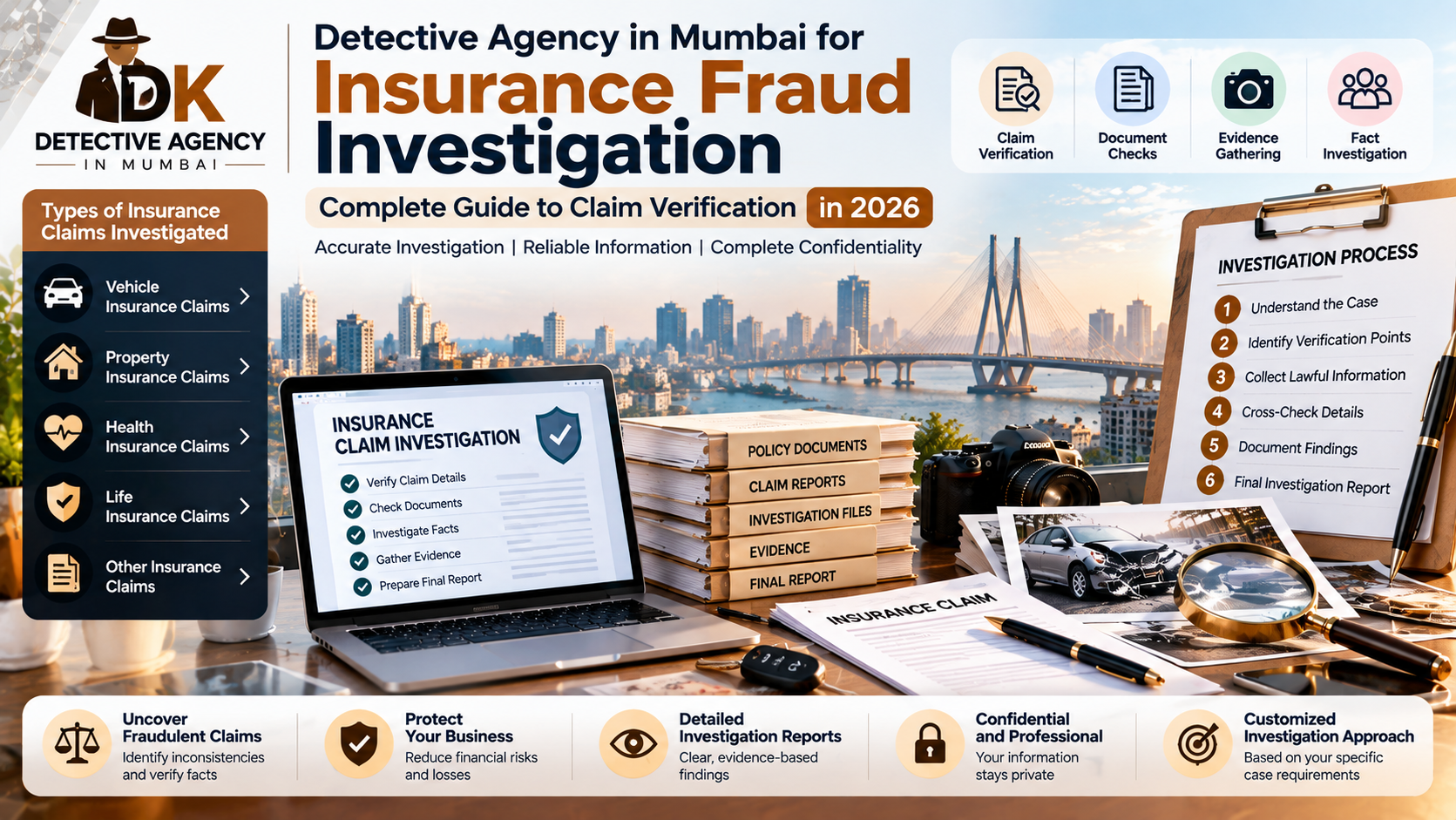

Insurance is designed to provide financial protection when unexpected events occur. However, some claims may contain inaccurate information, exaggerated losses, misleading documents, or other inconsistencies. When a claim requires closer examination, an insurance fraud investigation can help uncover facts and verify the information available.
A detective agency in Mumbai for insurance fraud investigation may assist businesses, insurers, legal professionals, and other authorized parties by collecting relevant information and conducting lawful verification.
This guide explains what insurance fraud investigation involves, the types of claims that may require additional verification, and how professional investigators can approach such cases.
What Is Insurance Fraud Investigation?
Insurance fraud investigation is the process of examining a suspicious or disputed insurance claim to determine whether the information provided is consistent with available evidence.
An investigation may involve checking documents, verifying circumstances, speaking with relevant individuals, reviewing publicly available information, and examining other lawful sources of evidence.
The purpose is not simply to prove that a claim is fraudulent. A professional investigation should focus on establishing facts and identifying inconsistencies that can be reviewed by the authorized decision-makers.
Why Are Insurance Claims Investigated?
Most insurance claims are submitted for legitimate reasons. However, certain circumstances may require additional verification.
Examples can include:
- Significant differences between documents and statements
- Unusual claim circumstances
- Questions about the timing of an incident
- Conflicting information from different sources
- Unclear ownership or loss details
- Suspicious supporting documents
- Repeated inconsistencies in a claim
- Claims involving unusually complicated circumstances
An unusual claim is not automatically fraudulent. Additional investigation is used to understand the facts before a conclusion is reached.
Types of Insurance Fraud Investigation
Insurance fraud can involve different types of policies and claims. The investigation approach depends on the nature of the case.
Vehicle Insurance Claims
Vehicle-related investigations may involve accidents, theft claims, damage reports, or questions about the circumstances surrounding an incident.
Investigators may verify information such as:
- Vehicle ownership
- Accident circumstances
- Reported damage
- Location details
- Available witnesses
- Relevant documentation
The investigator should work within applicable laws and use only legitimate methods of verification.
Property Insurance Claims
Property claims can involve homes, offices, shops, warehouses, or other insured locations.
An investigation may examine whether the reported loss matches the available information about the property and incident.
Relevant areas may include:
- Property details
- Reported damage
- Ownership information
- Incident timeline
- Supporting documents
- Available photographs or records
The objective is to establish what can be verified rather than making assumptions about the claimant.
Health Insurance Claims
Health-related claims can involve sensitive personal information. Any investigation in this area requires particular care regarding privacy, authorization, and applicable laws.
Depending on the circumstances, verification may focus on documentation and claim-related information that the investigator is legally permitted to access.
Sensitive medical information should never be obtained through unauthorized methods.
Life Insurance Claims
Life insurance investigations can involve verifying information associated with a claim and reviewing relevant records through lawful channels.
The exact investigation requirements can vary depending on the circumstances, policy terms, and applicable legal procedures.
Because these cases can involve highly sensitive personal information, proper authorization and documentation are particularly important.
Common Warning Signs That May Require Verification
There is no single sign that proves insurance fraud. However, certain inconsistencies can justify additional review.
For example:
Conflicting Statements
Different versions of an incident may raise questions that need clarification.
Unclear Timelines
If the reported sequence of events does not match available information, investigators may examine the timeline more closely.
Inconsistent Documents
Differences between submitted documents can require verification.
Unusual Claim Circumstances
A claim involving unusual circumstances may require additional fact-checking before a decision is made.
Unclear Ownership
When ownership or possession of an insured item is uncertain, relevant records may need to be checked.
These signs should be treated as investigation points, not automatic proof of wrongdoing.
How a Detective Agency in Mumbai May Handle an Insurance Investigation
Detective Agency in Mumbai investigation generally begins with understanding the case requirements.
Step 1: Understanding the Case
The investigator reviews the information supplied by the authorized client and identifies the specific questions that need to be answered.
Step 2: Identifying Verification Points
The investigator determines which facts require confirmation.
For example, this could involve the reported date, location, ownership, incident circumstances, or supporting documentation.
Step 3: Collecting Lawful Information
Relevant information is gathered through legally permissible sources and methods.
This may include publicly available records, authorized documents, interviews, or other appropriate sources.
Step 4: Cross-Checking Information
Information from different sources can be compared to identify agreements, inconsistencies, or gaps.
Step 5: Documenting Findings
Findings should be organized clearly so that the client can understand what was verified and what remains uncertain.
Step 6: Preparing the Investigation Report
A professional report may summarize the investigation process, relevant observations, supporting evidence, and areas requiring further review.
The report should distinguish between verified facts and assumptions.
Importance of Document Verification
Documents can play an important role in insurance investigations.
Depending on the case, relevant documents may include:
- Insurance policy documents
- Claim forms
- Bills and invoices
- Ownership records
- Incident reports
- Photographs
- Repair estimates
- Supporting correspondence
Investigators should not alter, fabricate, or improperly obtain documents. The purpose of verification is to establish whether available documentation is consistent with the reported claim.
Interviewing Relevant People
People who witnessed an incident or have direct knowledge of the circumstances may provide useful information.
An investigator may conduct lawful interviews with relevant individuals where appropriate.
Questions should focus on facts related to the case rather than pressuring someone into providing a particular answer.
Information obtained during interviews should be documented accurately and presented in context.
Using Publicly Available Information
Open-source information can sometimes help investigators verify basic facts.
Depending on the case, publicly available sources may include:
- Business information
- Public records
- Published photographs
- Official websites
- Public announcements
- Other openly accessible information
The availability of information does not automatically mean that it can be used for every purpose. Investigators should consider privacy, copyright, data protection, and other applicable legal requirements.
Why Evidence Documentation Matters
An investigation is more useful when its findings can be clearly explained.
Good documentation should identify:
- What was checked
- When it was checked
- Where the information came from
- What was observed
- What could be verified
- What could not be confirmed
This approach makes the final report easier to understand and reduces the risk of confusing observations with conclusions.
How Long Can an Insurance Investigation Take?
There is no fixed timeline for every insurance investigation.
The duration can depend on factors such as:
- Complexity of the claim
- Number of people involved
- Availability of records
- Location of relevant information
- Number of verification points
- Cooperation of relevant parties
- Scope of the investigation
A straightforward document-verification assignment may require less time than a complex claim involving multiple locations and conflicting information.
A realistic timeline should be discussed after the investigator understands the case requirements.
What Should You Ask Before Hiring an Investigation Agency?
If an organization is considering professional investigative assistance, it is useful to ask clear questions before starting.
Consider asking:
- What is the proposed scope of the investigation?
- Which information will be verified?
- What investigation methods will be used?
- How will confidential information be handled?
- What type of report will be provided?
- What documentation will the client receive?
- What are the expected timelines?
- Are the proposed methods lawful and appropriate?
Clear communication at the beginning can prevent misunderstandings later.
Privacy and Legal Considerations
Insurance investigations can involve personal, financial, medical, property, and other sensitive information.
For this reason, investigators should operate within applicable laws and respect privacy rights.
A professional investigator should not:
- Hack accounts
- Obtain passwords through deception
- Access private accounts without authorization
- Install unauthorized tracking software
- Impersonate officials
- Fabricate evidence
- Illegally access confidential records
The goal of an investigation should be lawful fact-finding, not unauthorized access to private information.
How Insurance Investigations Can Help Businesses
For insurers and organizations dealing with large numbers of claims, independent verification can provide additional information when a claim contains unresolved questions.
An investigation may help an authorized organization:
- Verify reported facts
- Identify information gaps
- Clarify conflicting statements
- Organize supporting evidence
- Document relevant findings
- Support internal claim review
An investigation does not replace the insurer’s own claims process or legal decision-making. It provides information that authorized decision-makers can evaluate.
Insurance Fraud Investigation in Mumbai
Mumbai is a large and highly active commercial city, and insurance claims can involve many different locations, businesses, properties, vehicles, and individuals.
A detective agency in Mumbai for insurance fraud investigation may therefore be engaged when a case requires local verification or independent information gathering.
The scope can range from a focused document check to a broader investigation involving multiple verification points.
Each case should be assessed individually rather than using the same investigation process for every claim.
Choosing a Professional Investigation Approach
The quality of an investigation depends on more than simply collecting information.
A professional approach should focus on:
- Clear objectives
- Lawful methods
- Accurate documentation
- Source verification
- Confidential handling of information
- Neutral reporting
- Evidence-based findings
The investigator should report what the evidence shows without exaggerating findings or presenting assumptions as facts.
Frequently Asked Questions
What is insurance fraud investigation?
Insurance fraud investigation involves examining a claim and verifying relevant information when there are questions, inconsistencies, or other reasons for additional review.
Can a detective agency investigate an insurance claim?
An investigation agency may assist an authorized client with lawful fact-checking and information gathering, depending on the case and applicable laws.
Does a suspicious claim automatically mean fraud?
No. A suspicious or unusual claim does not automatically prove fraud. Investigation is intended to establish facts and clarify inconsistencies.
What types of insurance claims can be investigated?
Depending on the case, investigations may involve vehicle, property, health, life, or other types of insurance claims.
How is evidence documented?
Evidence and findings can be organized through notes, photographs, authorized documents, interviews, publicly available information, and formal investigation reports, depending on the circumstances.
How long does an insurance investigation take?
The timeline depends on the complexity of the case, available information, number of verification points, and cooperation from relevant parties.
Is insurance investigation legal?
Lawful insurance investigation can be conducted when appropriate authorization exists, and investigators follow applicable laws, privacy requirements, and evidence-handling standards.
Final Thoughts
Insurance fraud investigation is primarily about verification and fact-finding. When a claim contains unanswered questions or conflicting information, a structured investigation can help an authorized organization understand the circumstances more clearly.
A detective agency in Mumbai for insurance fraud investigation may assist with document verification, information gathering, interviews, timeline checks, and other lawful investigative activities.
The most important part of any investigation is maintaining accuracy and respecting legal and privacy boundaries. Findings should be based on verifiable information, clearly documented, and presented without assumptions.
When handled professionally, an insurance investigation can provide useful information for organizations that need to review a complex or disputed claim.