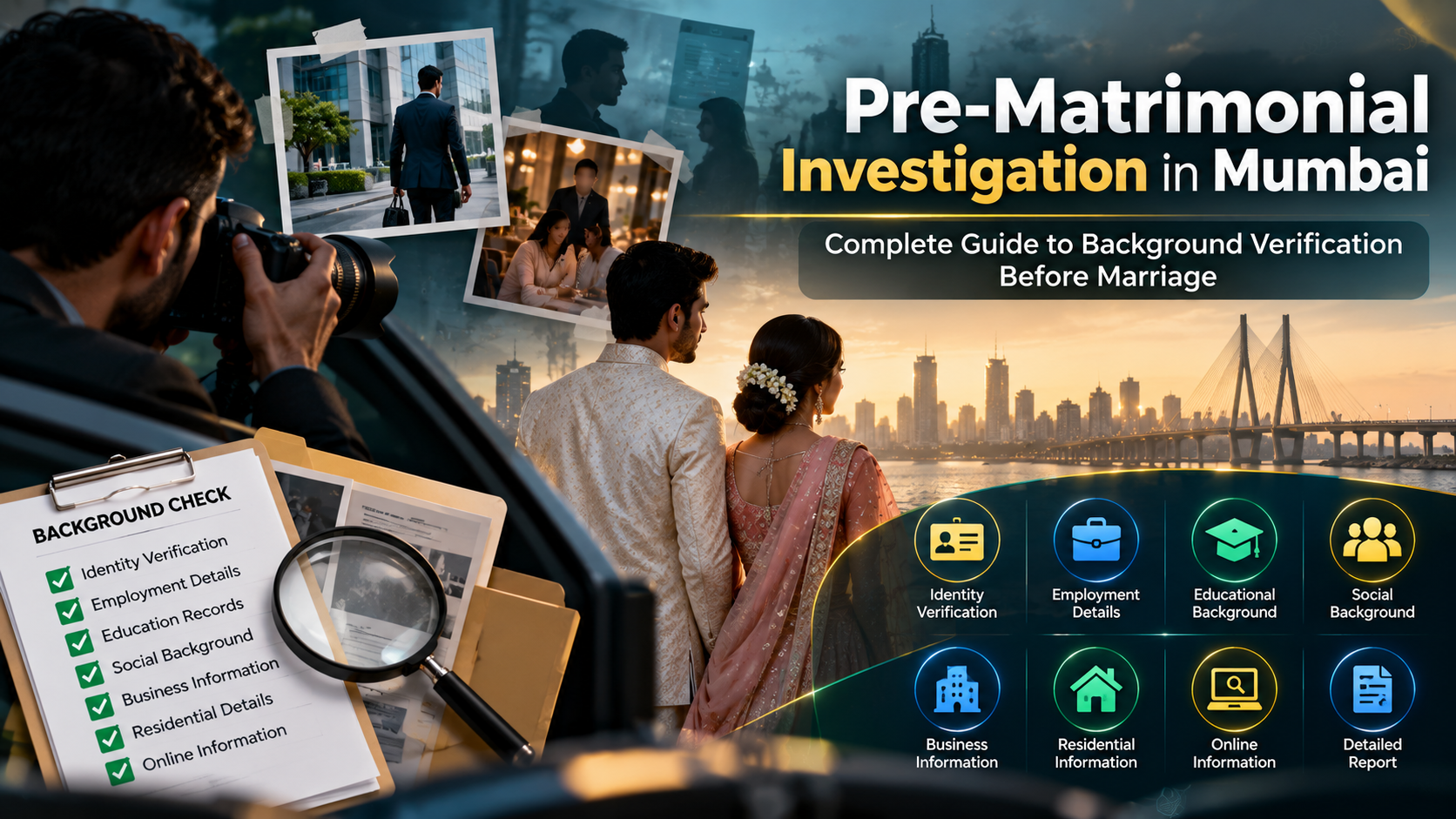
Marriage is an important personal decision, and having reliable information about a prospective partner can help families understand relevant background details before making long-term commitments. A pre-matrimonial investigation in Mumbai generally focuses on verifying information that has been voluntarily shared about a prospective partner, such as identity, employment, education, social background, and other relevant details.
A professional investigation should respect privacy, applicable laws, and personal boundaries. The purpose is to verify information responsibly rather than make assumptions about someone’s character.
What Is a Pre-Matrimonial Investigation?
A pre-matrimonial investigation is a background verification process conducted before marriage. It may be requested by an individual or family who wants to verify important information about a prospective partner.
Depending on the assignment and applicable laws, an investigation may examine publicly available information and legally obtainable records.
Common areas may include:
- Identity information
- Employment details
- Educational background
- Business information
- Residential information
- General social background
- Previously provided personal information
- Publicly available online information
The exact scope depends on the client’s requirements and what information can legally and ethically be verified.
Why Consider Pre-Matrimonial Verification in Mumbai?
Mumbai is a large and diverse city where people may have professional, residential, and social connections across different parts of the city and surrounding regions.
Information shared during a marriage discussion may sometimes be incomplete or outdated. Verification can help identify inconsistencies between information provided by a prospective partner and information that can be independently confirmed.
A pre-matrimonial investigation in Mumbai may therefore help families organize relevant facts before making an important personal decision.
What Information Can Be Verified?
A professional investigator may focus on specific information that is relevant to the assignment.
1. Identity Verification
Identity verification can help establish whether basic information provided by the individual is consistent with available documentation or lawful sources.
This may include checking:
- Name
- General identity details
- Professional information
- Residential information
- Other relevant details provided during the assignment
2. Employment Verification
Employment claims can sometimes be important when discussing marriage arrangements.
Depending on the circumstances, investigators may verify information such as:
- Current employment
- Professional designation
- Business association
- General employment history
- Public professional information
Verification should rely on lawful methods and appropriate sources.
3. Educational Background
Educational qualifications may also be verified when they are relevant to information provided by a prospective partner.
This can help identify whether stated qualifications and institutions are consistent with information that can be independently confirmed.
4. Business Background
If a prospective partner operates a business, publicly available business information may provide useful background context.
Verification can include information such as:
- Business name
- Business activity
- Professional association
- Public registration information
- General business history
The availability of specific information depends on applicable records and legal access.
Understanding Social Background Checks
A social background check is different from making personal judgments about an individual.
The objective is to verify relevant factual information and identify inconsistencies where possible.
An investigator may review lawful and publicly available information relating to:
- Professional associations
- Public business activities
- General social connections
- Public online profiles
- Information relevant to the assignment
Private communications, protected accounts, or confidential information should not be accessed without proper authorization.
What Is the Role of Online Information?
Online information can sometimes help establish basic background details, but it should not automatically be treated as proof.
Social media profiles, professional websites, public directories, and other online sources may contain outdated, incomplete, or inaccurate information.
A responsible investigator should therefore compare information from multiple appropriate sources instead of relying on a single online profile.
How a Pre-Matrimonial Investigation Usually Works
The process can vary depending on the investigation requirements.
Step 1: Initial Consultation
The client explains what information needs to be verified and why the verification is required.
Step 2: Define the Investigation Scope
The investigator identifies the specific areas that can reasonably and lawfully be checked.
Step 3: Information Collection
Relevant information provided by the client is organized for verification.
Step 4: Background Verification
The investigator checks appropriate sources and attempts to confirm the relevant information.
Step 5: Cross-Checking
Important findings can be compared against information supplied during the marriage discussion.
Step 6: Report Preparation
The verified information can be organized into a structured report, subject to the scope and lawful collection methods used during the assignment.
Signs That Information May Need Verification
Verification does not mean assuming that someone has provided false information.
However, certain inconsistencies may justify additional fact-checking.
Examples can include:
- Major differences between stated and independently available employment information
- Conflicting educational details
- Inconsistent business information
- Significant differences in previously provided background details
- Information that cannot be reasonably confirmed
Such observations should be treated as points requiring clarification rather than automatic conclusions.
Privacy and Legal Considerations
Privacy is an important part of any personal investigation.
A pre-matrimonial investigation in Mumbai should be conducted using lawful and ethical methods. Investigators should avoid unauthorized access to private accounts, confidential communications, protected databases, or personal devices.
Clients should also understand that not every requested piece of information can legally be obtained.
A professional investigation focuses on legitimate verification rather than intrusive surveillance.
How to Choose the Scope of an Investigation
Not every situation requires an extensive investigation.
Before beginning, it can be useful to identify the most important questions.
For example:
- Which employment details need verification?
- Are educational qualifications important?
- Is business information relevant?
- Which identity details need confirmation?
- Are there specific inconsistencies that require clarification?
A clearly defined scope can make the investigation more focused and reduce unnecessary collection of personal information.
Why Professional Documentation Matters
A structured investigation report can make information easier to understand.
Instead of relying on informal conversations or isolated online searches, a report can organize relevant findings according to the agreed investigation scope.
Depending on the assignment, documentation may include:
- Verified information
- Source-based observations
- Relevant inconsistencies
- Investigation dates
- Supporting information where legally appropriate
- Areas that could not be independently confirmed
The report should distinguish between verified facts and observations.
Common Mistakes to Avoid
People conducting personal background checks may sometimes rely too heavily on online searches or assumptions.
Common mistakes include:
- Treating social media information as complete proof.
- Assuming an unverified claim is automatically false.
- Using unauthorized methods to obtain private information.
- Ignoring outdated information.
- Focusing on rumors instead of verifiable facts.
- Collecting unnecessary personal information.
- Making decisions based on a single source.
A professional approach emphasizes verification, documentation, and appropriate privacy standards.
When Should You Consider Background Verification?
Pre-matrimonial verification may be considered when an individual or family wants additional clarity about important information before marriage.
It can be particularly relevant when:
- Important background information cannot be independently confirmed.
- There are significant inconsistencies in provided details.
- Employment or business claims require verification.
- Educational qualifications are important to the discussion.
- Families want factual background information before proceeding further.
The purpose should be informed understanding rather than unnecessary intrusion.
Questions to Ask an Investigation Agency
Before starting an investigation, clients can ask:
- What information can legally be verified?
- What is included in the investigation?
- What sources will be used?
- How will personal information be handled?
- How are findings documented?
- What information cannot be obtained?
- How long is the investigation expected to take?
- What will the final report contain?
Clear communication at the beginning can help establish realistic expectations.
Frequently Asked Questions
What is a pre-matrimonial investigation?
A pre-matrimonial investigation is a background verification process conducted before marriage to check relevant information about a prospective partner independently.
Is pre-matrimonial investigation legal in Mumbai?
Investigations should follow applicable Indian laws and privacy requirements. Information should be obtained through lawful and appropriate methods.
What can be checked during a matrimonial investigation?
Depending on the assignment, relevant areas may include identity, employment, education, business information, residential details, and publicly available background information.
Can social media profiles be checked?
Publicly available social media information may be reviewed when relevant, but it should not automatically be considered complete or conclusive evidence.
How long does a pre-matrimonial investigation take?
The timeframe depends on the investigation scope, available information, locations involved, and the type of verification required.
Should every detail about a prospective partner be investigated?
Not necessarily. A focused investigation should concentrate on relevant information and respect privacy and legal boundaries.
Final Thoughts
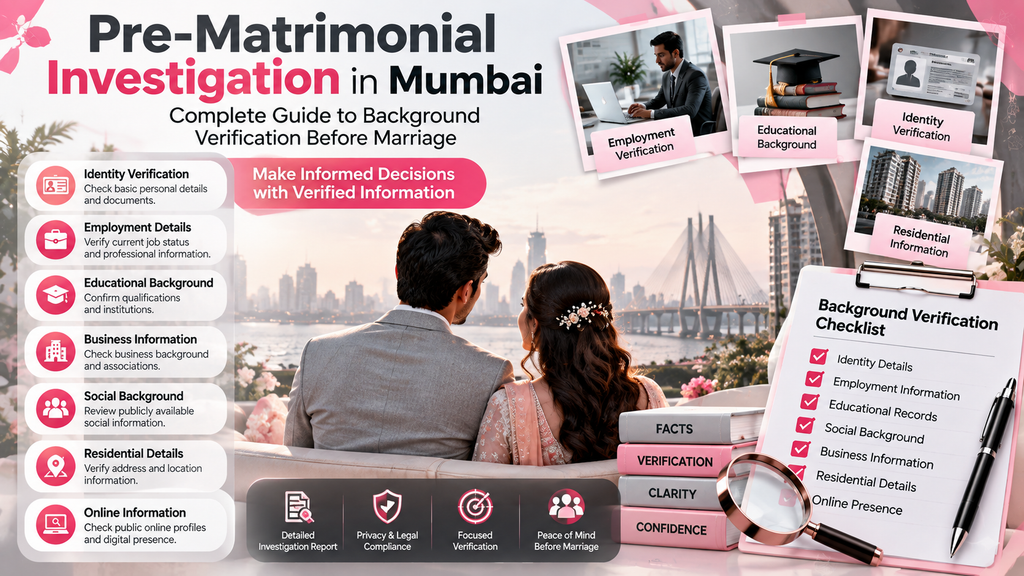
A pre-matrimonial investigation in Mumbai can provide structured background information when important details about a prospective partner need independent verification. The process should focus on relevant facts, lawful information sources, responsible documentation, and respect for privacy.
Before making an important personal decision, carefully verified information can provide greater clarity than assumptions, rumors, or isolated online searches. A professional investigation should therefore focus on factual verification while maintaining appropriate ethical and legal standards.