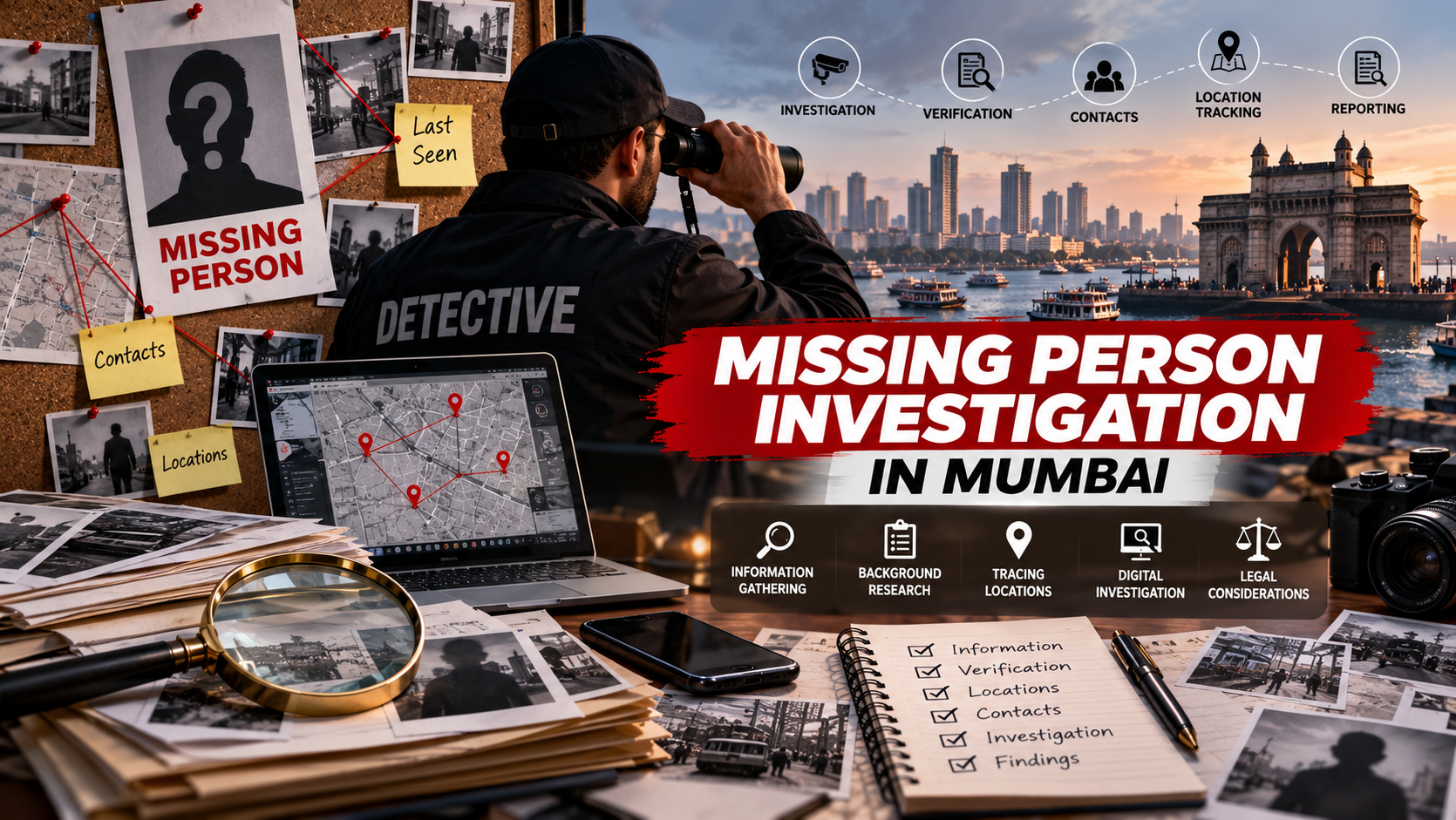
When a person suddenly goes missing, family members and close contacts may face uncertainty, stress, and many unanswered questions. Mumbai is a large and busy city, so locating someone may require organized information gathering and careful investigation.
A missing person investigation in Mumbai can involve reviewing available information, understanding the person’s recent activities, identifying relevant connections, checking appropriate public sources, and developing leads that may help establish their whereabouts.
Professional investigators can assist with organizing these activities while following applicable laws and privacy requirements. This guide explains the general investigation process, the information that may be useful, and important considerations when looking for a missing person.
What Is a Missing Person Investigation in Mumbai?
A missing person investigation is an organized effort to gather information that may help determine where a person is or what may have happened to them.
The circumstances can vary considerably. A person may be missing because of a communication breakdown, an unexpected journey, a personal situation, an accident, or another circumstance.
A professional investigation may involve:
- Collecting information about the missing person
- Reviewing known locations
- Identifying relevant contacts
- Establishing a timeline
- Checking available public information
- Following legitimate leads
- Verifying information before drawing conclusions
- Documenting findings systematically
The exact approach depends on the circumstances of each case.
When Can Professional Investigation Help?
A missing person search may become complicated when family members have limited information about the person’s recent activities or cannot establish where the person may have gone.
Professional investigative assistance may be considered when:
- The person’s current location is unknown
- Available information is incomplete
- Family members need help organizing leads
- There are multiple locations or contacts to examine
- Previous information needs independent verification
- A structured search process is required
A private investigator does not replace the police or emergency services. If someone is missing under circumstances involving immediate danger, suspected abduction, violence, or another emergency, contacting the appropriate authorities should be a priority.
Information to Collect Before Starting an Investigation
Accurate information can provide a useful starting point for an investigation.
Family members or authorized individuals may collect information such as:
- Full name
- Recent photograph
- Age
- Physical description
- Last known location
- Approximate time last seen
- Known phone numbers
- Known addresses
- Workplace or educational institution
- Names of relevant contacts
- Recent travel information
- Vehicle details, when applicable
- Known medical or accessibility information where appropriate
- Any relevant documents
The more accurate the information, the easier it can be to establish a reliable starting timeline.
Avoid guessing when information is uncertain. Clearly distinguish between confirmed facts and assumptions.
How Missing Person Investigations Typically Begin
A professional investigation generally begins with an initial information-gathering stage.
The investigator may first establish:
- Who the missing person is
- When they were last known to be present
- Where they were last seen or known to be
- Who may have recently communicated with them
- Which locations may be relevant
- What information has already been checked
- Which leads remain unresolved
Creating a timeline can be particularly useful.
For example, investigators may organize known events chronologically:
Last confirmed location → last communication → known movement → relevant contact → unexplained gap
This approach helps separate confirmed information from assumptions.
Background Research and Information Verification
Background research can help investigators understand the person’s known circumstances and identify information that may require further verification.
Depending on the case and applicable permissions, investigators may examine legitimate sources such as:
- Publicly available information
- Previously provided records
- Known addresses
- Professional connections
- Relevant public profiles
- Public business information
- Information supplied by family members
The purpose of this research is not to collect unrelated personal information. It should remain connected to the legitimate objective of locating the missing person.
Information should also be verified wherever possible. A single unconfirmed statement should not automatically be treated as evidence.
Tracing Known Locations and Connections
Locations and personal connections can provide useful investigative leads.
Investigators may review the person’s known relationship with:
- Family members
- Friends
- Colleagues
- Educational institutions
- Workplaces
- Frequently visited locations
- Known accommodation
- Relevant travel points
The purpose is to establish a reasonable sequence of events rather than to intrude into unrelated private activities.
If a particular location appears repeatedly in reliable information, it may become an important part of the investigation timeline.
Digital and Public-Source Information
Modern communication can sometimes leave publicly available information that helps establish a timeline.
Depending on the circumstances and applicable laws, investigators may review legitimate public sources such as:
- Public social media information
- Public business listings
- Publicly available photographs
- Open online profiles
- Public announcements
- Other lawful online sources
Investigators should not obtain private account passwords, bypass security controls, impersonate individuals, or access restricted accounts without proper authorization.
Digital information should be treated carefully because online content can be outdated, incomplete, misleading, or posted by someone other than the missing person.
How Investigators Organize Collected Information
Large investigations can produce many pieces of information. Organizing those details is important.
An investigator may maintain a structured record containing:
InformationPurpose
Last known location Establishes a starting point
Time last seen Helps create a timeline
Known contacts Identifies possible leads
Relevant locations Supports location-based research
Communications Helps establish chronology
Verified observations Separates facts from assumptions
Follow-up leads Tracks outstanding questions
This type of organization helps reduce confusion and prevents the same information from being repeatedly investigated.
Why Accurate Information Matters
A missing person investigation can be affected by inaccurate or incomplete information.
For example, an incorrect last-known location can send an investigation in the wrong direction. Similarly, an outdated phone number or incorrect assumption about a person’s recent activities can create unnecessary delays.
For this reason, information should ideally be categorized as:
- Confirmed
- Reported but unverified
- Possible lead
- Unknown
This simple distinction can improve the quality of the investigation.
Legal and Privacy Considerations
Privacy and legal requirements are important when conducting any investigation.
A legitimate investigation should respect applicable laws and avoid unauthorized access to private information.
Investigators should not:
- Hack private accounts
- Obtain passwords unlawfully
- Impersonate another person
- Access restricted databases without authorization
- Install unauthorized tracking software
- Record private communications unlawfully
- Harass people connected to the investigation
- Publish sensitive personal information unnecessarily
The appropriate investigative methods depend on the circumstances and applicable Indian laws and regulations.
When there is an immediate safety concern or suspected criminal activity, the appropriate law-enforcement authorities should be contacted.
Why Family Information Can Be Valuable
Family members often possess information that may not be immediately available elsewhere.
Useful details can include:
- Recent photographs
- Daily routines
- Important contacts
- Commonly visited locations
- Recent conversations
- Known travel plans
- Workplace information
- Educational details
- Personal belongings that may help establish context
Family members should provide information as accurately as possible and clearly identify anything they are uncertain about.
Common Mistakes to Avoid During a Search
A disorganized search can sometimes create confusion or cause useful information to be overlooked.
Relying on Unverified Information
A message or online post should not automatically be treated as confirmed information.
Sharing Sensitive Information Publicly
Publishing private phone numbers, identification documents, addresses, or other sensitive details can create additional privacy and security risks.
Contacting Unknown People Aggressively
People connected to a missing person should be approached appropriately and lawfully.
Ignoring the Timeline
Small details about time and location can become important when combined with other verified information.
Delaying Contact With Authorities
If there is a genuine emergency or concern about immediate safety, appropriate authorities should be contacted promptly rather than relying exclusively on a private investigation.
How to Choose Information for an Investigator
When approaching a professional investigator, prepare a concise case summary.
It can include:
Person: Full name and basic identifying information.
Last Known Location: Where the person was last confirmed to be.
Last Known Time: When they were last seen or contacted.
Recent Activity: Relevant information about recent movements or communication.
Known Contacts: People who may have useful information.
Documents: Relevant records or photographs, where appropriate.
Previous Steps: Actions already taken to locate the person.
A clear summary can help the investigator understand the circumstances before beginning further work.
What Happens After a Potential Lead Is Found?
A potential lead should be verified before it is treated as reliable information.
For example, an unconfirmed online post may indicate a possible location, but additional verification may be necessary.
A structured process may involve:
- Recording the lead.
- Identifying its source.
- Checking whether the information is current.
- Comparing it with existing facts.
- Determining whether further lawful investigation is appropriate.
- Documenting the result.
This approach reduces the risk of treating speculation as fact.
Frequently Asked Questions About Missing Person Investigation in Mumbai
What is a missing person investigation?
It is a structured process of gathering and verifying information that may help determine the whereabouts or circumstances of a missing person.
What information should I provide to an investigator?
Useful information can include the person’s name, recent photograph, last known location, approximate time last seen, known contacts, recent activities, and relevant documents.
Can a private investigator replace the police?
No. Private investigators and law-enforcement authorities have different roles. In emergencies or suspected criminal cases, the appropriate authorities should be contacted.
Can investigators access someone’s private social media account?
Investigators should not hack accounts, obtain passwords unlawfully, or bypass privacy and security controls. Any digital investigation should use lawful and authorized methods.
Why is a timeline important?
A timeline organizes known events by date and time, helping investigators identify gaps, connections, and information that may require verification.
What if the information I have is incomplete?
Provide what you know and clearly identify uncertain details. Incomplete information can still provide a starting point for further lawful investigation.
Should I share personal information publicly during a search?
Sensitive personal information should be handled carefully. Publicly sharing private addresses, identification documents, phone numbers, or other sensitive information can create additional risks.
Conclusion
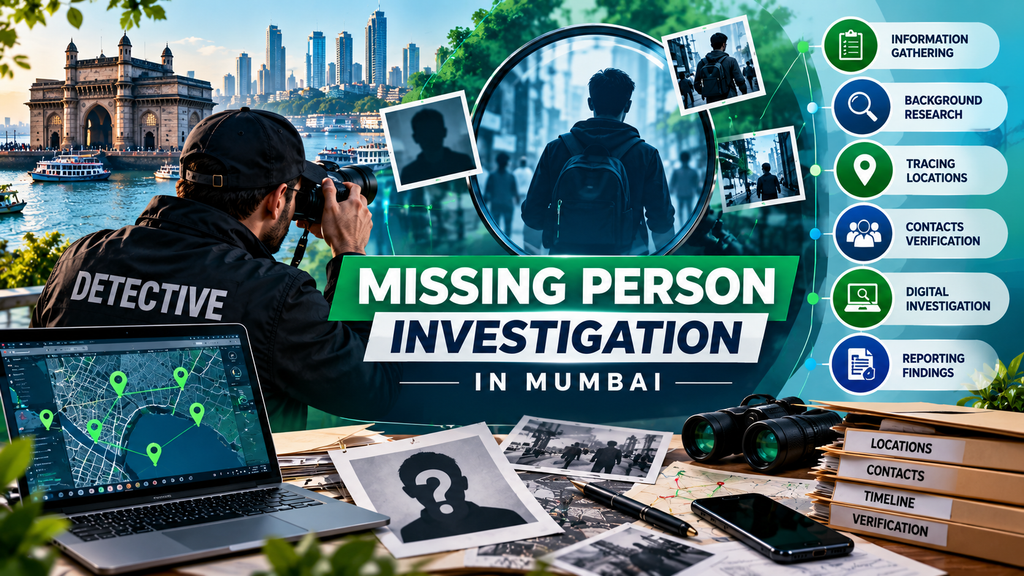
A missing person investigation in Mumbai requires careful information gathering, timeline development, lead verification, and responsible investigation practices. Accurate details about the person’s last known location, recent activities, contacts, and movements can provide an important foundation for the search.
Professional investigators may help organize information, examine legitimate sources, identify relevant leads, and document findings. However, investigations should always respect privacy, legal requirements, and individual rights.
When a missing person may be in immediate danger or a crime is suspected, contacting the appropriate authorities should remain a priority. A structured and lawful approach can help ensure that available information is handled carefully while the search continues.